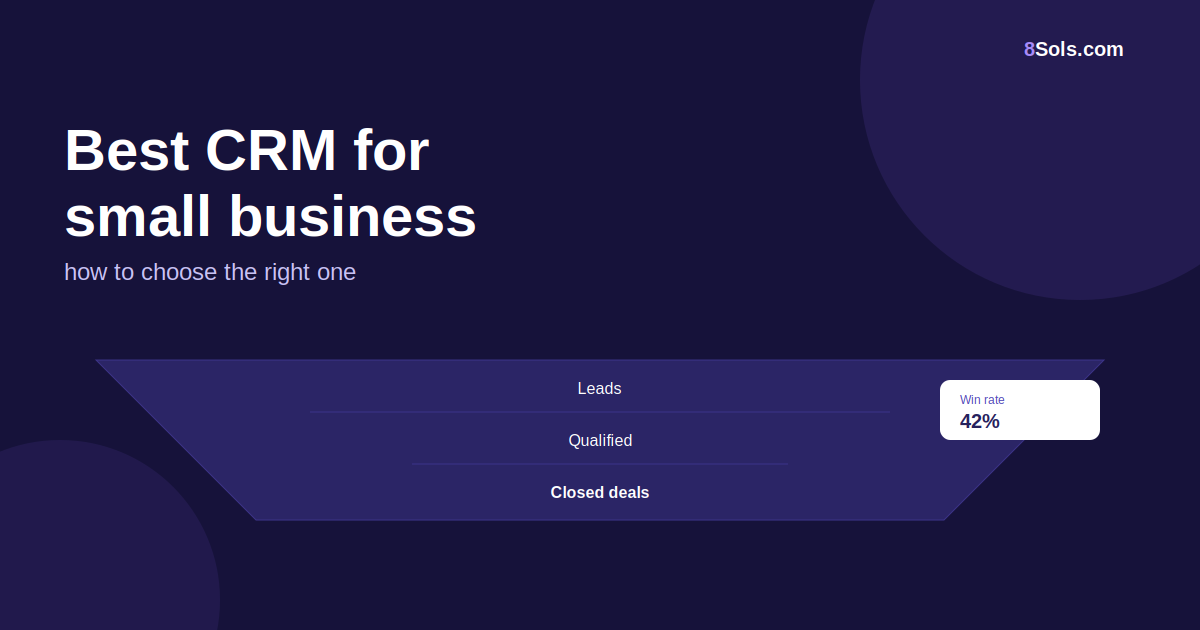
Every small business eventually hits the same wall: your sales pipeline lives in someone's head, a spreadsheet, or a pile of sticky notes — and a deal slips through the cracks.
That's the exact problem a CRM (Customer Relationship Management system) solves. It's software that tracks every lead, conversation, and deal in one place, so nothing depends on memory.
But "best CRM for small business" isn't a one-size-fits-all answer. The right choice depends heavily on how your sales process actually works.
Strip away the marketing language, and a good CRM gives you:
If a CRM isn't doing these four things well, it's probably the wrong fit — regardless of how popular the brand is.
This is the real decision point for most small businesses.
| Off-the-Shelf CRM | Custom CRM | |
|---|---|---|
| Setup time | Fast (days) | Longer (weeks) |
| Cost structure | Monthly per-user fees | Upfront build, no per-seat fees |
| Best for | Standard sales processes | Unique workflows, industry-specific needs |
| Flexibility | Limited to vendor's features | Built around your process |
A lot of businesses start with an off-the-shelf tool, then outgrow it within a year or two because their sales process doesn't fit the software's assumptions. That's usually when a custom CRM system starts making more sense.
Before you commit to anything, map out your actual sales process on paper: every stage a lead goes through from first contact to closed deal. Then ask whether a given CRM supports that process — not a generic one.
According to industry research on CRM adoption, the systems that succeed long-term are the ones aligned closely with how a sales team already works, not the ones forcing a new process onto the team.
There's no universal "best" CRM — only the best fit for your sales process, team size, and growth plans. If your current setup (or current CRM) feels like it's fighting you instead of helping you close deals, it's worth a second look.
Not sure if you need off-the-shelf or custom? Talk to our team — we'll walk through your sales process and tell you honestly which direction makes sense.