Here's something most web development agencies won't tell you: not every business needs a custom web solution. A well-configured WordPress site or Shopify store genuinely does the job for thousands of businesses — and if that's where you are, paying for a custom build would be a waste of money.
But some businesses do reach a point where their current website stops being an asset and starts being a ceiling. This post is about how to tell the difference — honestly.
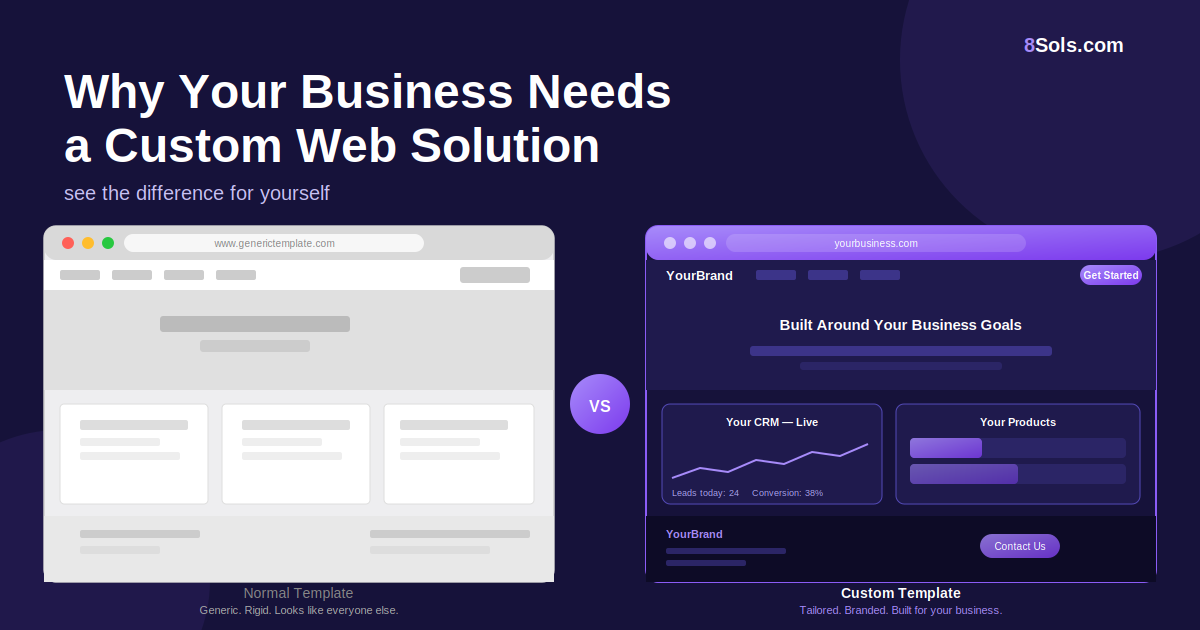
A custom web solution is a website or web application built specifically around your business — your workflows, your customer journey, your data, your growth plans — rather than assembled from a general-purpose template or platform.
The key word is specifically. It's not just a "nicer" website. It's a different category of thing: software that happens to live in a browser, built to solve a problem that off-the-shelf tools can't adequately address.
Off-the-shelf platforms exist for good reason. WordPress, Shopify, Wix, and their equivalents are fast to set up, backed by large communities, and genuinely capable for standard use cases. If your business has:
...then a well-built template site is probably the right call. Custom development costs more upfront and takes longer. If the off-the-shelf option does what you need, use it.
The decision to go custom isn't about ambition — it's about friction. Here are the signals that actually indicate you've hit the ceiling:
When your staff are manually exporting data between systems, copy-pasting information between tools, or maintaining spreadsheets to fill gaps your website can't handle — that's not a process problem, that's a platform problem.
Plugins and extensions can extend a template platform, but there's a limit. When your development or agency team is regularly telling you that what you need isn't possible without "hacking" the platform, you've likely reached it.
A business that's serious about growth needs its website, CRM, inventory, payments, and reporting to share data cleanly. When these integrations rely on fragile third-party connectors or manual exports, it creates errors and slows decisions. Custom solutions are built API-first — integrations are designed in, not bolted on.
Template platforms slow down as you add products, traffic, and plugins. If your site is getting slower over time despite maintenance, that's a structural issue — not something a caching plugin can fully fix.
Most SaaS platforms and template themes bundle features for an average user. If you're consistently paying for things you don't use while working around things you do need, the economics of a custom build start to change.
When the time is right, here's what the investment buys you — concretely, not theoretically:
A site built around your actual workflow. Every page, form, dashboard, and user flow is designed for how your business operates — not how the platform vendor assumed businesses operate.
Performance that scales with you. Custom codebases carry none of the bloat that comes bundled with general-purpose themes. Faster load times, better Core Web Vitals scores, and a foundation that handles traffic growth without structural changes.
Real integrations, not patchwork. Your custom web application connects directly to your CRM, ERP, payment processor, or any other system — built to share data reliably, not through a chain of third-party connectors.
Ownership, not rental. With a template platform, you're renting capability. With a custom build, you own the codebase and can evolve it freely without being dependent on a vendor's roadmap or pricing decisions.
The honest answer: custom development has a higher upfront cost than a template site. The financial case depends on what staying on your current platform is actually costing you.
Ask yourself:
When those costs — in time, in lost revenue, in monthly SaaS fees — start to approach or exceed the cost of a custom build, the economics shift. For many growing businesses, this happens earlier than they expect.
Going custom doesn't mean rebuilding everything at once. The most effective approach — and the one we recommend to most clients — is to start with the single biggest bottleneck. Fix that piece well. Then expand.
This reduces risk, gets you results faster, and avoids the "six-month rebuild" that stalls momentum and overspends budgets. If you're not sure where your biggest bottleneck is, that clarity is usually the first thing a good discovery process provides.
Not sure whether you've actually hit the ceiling, or just need a better configuration of what you have? Talk to the 8Sols team — we'll give you an honest read. We work with businesses across the UAE and US on everything from custom web applications to enterprise ERP solutions, and we've told plenty of clients they weren't ready for a custom build yet. We'd rather give you the right answer than the expensive one.
This post was researched and drafted with AI assistance, reviewed and edited by the 8Sols team.